
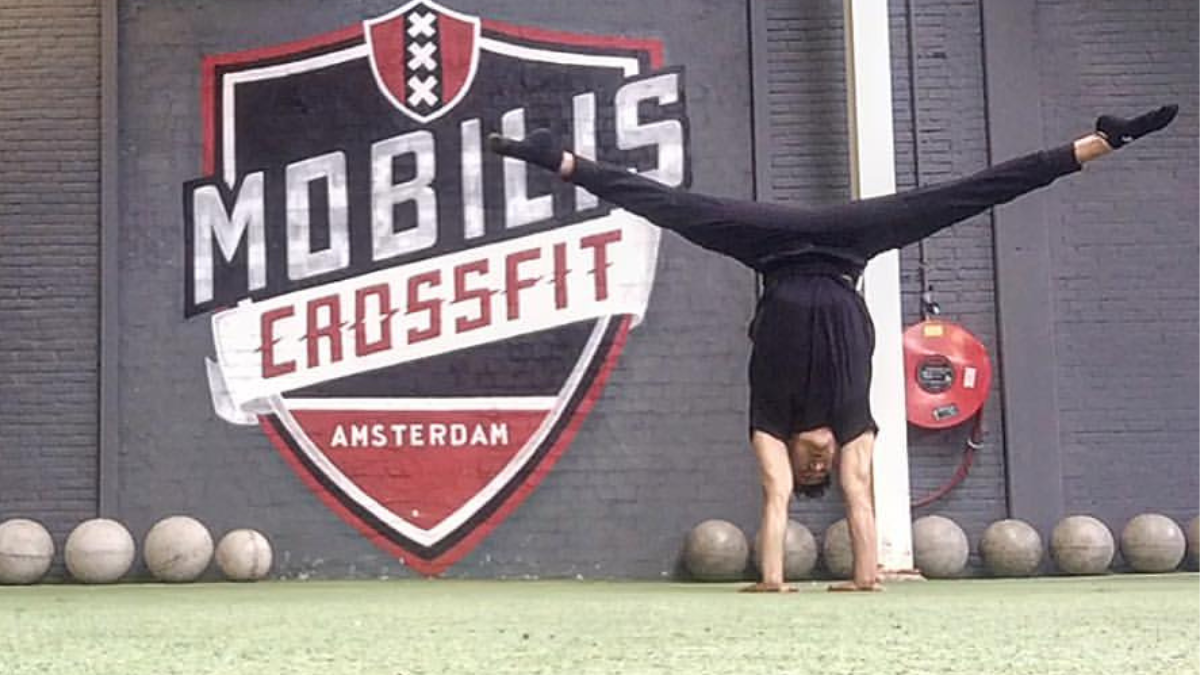
Handstands are impressive and can improve total body strength and overhead mobility. Yet, this is the handstand guide for tall people.
The most successful gymnasts will spend hours balancing upside down in a handstand & tend to be shorter and leaner.
Average female gymnast height is 4’6″ to 5’6″
Average male gymnast height is 5’3″ to 5’10”

So, if you’re the mountain from Game Of Thrones or just someone with longer limbs, you’ll need help learning to do a handstand if you’re tall.
In case you’re new, I’m Chris, a dad, online personal trainer and nutrition coach, & caffeine fiend.

From 2015 to 2020, I was lucky to travel around teaching various calisthenics workshops & one of my favorite topics was the handstand.
And before you say it, I didn’t grow up doing gymnastics; heck, I’m afraid of heights.
Also, on a good day, I’m 5’10, but I have freakishly long legs, making most hand balancing and calisthenics movements more challenging.
If you want to learn more about coaching you should click here.
So, read on, don’t skip around, and remember, handstands are supposed to be fun.
And the handstand guide for tall people will help you get your first handstand.
The Handstand Guide For Tall People
Handstands are rad, and there are many articles, YouTube videos, and social media posts featuring folks showing their Cirque du Soleil hand-balancing.
You are not a professional handbalancer, and if you are, why are you reading this article?
All jokes aside, this article aims to help you overcome the fear of being upside down & comfortable balancing on your hands if you’re tall.
The same concepts apply even if you’re not tall.
The Key To Learning A Handstand If You’re Tall
Handstands are a skill.
You can’t muscle your way through a handstand.
Yes, you can certainly use your legs as a counterbalance & planche forward; however, you risk an injury.
A well-balanced handstand can help you develop full-body strength and make learning more advanced skills easier.
But beyond strength alone, it’s vital to remember that performing a handstand is a skill.
Skill implies that you are going to make a BUNCH of mistakes.
Also, practicing a skill means being okay with imperfection…because perfect doesn’t exist.
If you were brand new to the gym, you would not step up to the squat rack and squat 225 pounds with perfect form.
Heck, you might not even squat with a barbell.
In each session, you practice using different progressions. As you continue to practice, your form will improve.
Just remember, strength is a skill that takes time to develop.
What Should A Handstand Look Like For Tall People?
What should a handstand look like & why is it more challenging if you’re tall?
Gymnasts and circus performers in the early 20th century adopted a curved back in their handstands resembling a banana.

The curved position allows the legs to act as a counterbalance and, when intentionally performed, eventually leads to a handstand progression called the Mexican.

The banana back handstand happens when the hips can’t properly stack over the shoulder joint, resulting in what is better known as planching.
Planching is an advanced straight-arm movement that places tremendous stress on the shoulder, elbow, and wrist joints.
If someone has longer legs and is in the banana-backed position, they will have a more challenging time staying in the handstand.
Straight Body vs. Banana Backed Handstand
The ideal handstand position is a straight line from the tips of your toes to the palms of your hands.

Think of your handstand line as “stacking the blocks.”

The straight line differs from the banana-backed position because it becomes easier to create full-body tension.
You will reduce the risk of injury to your joints and find it easier to learn more advanced handstand progressions, such as freestanding handstand push-ups, press-to-handstand, and handstand-to-planche.
Another bonus is the development of total body strength, which can carry over into weighted movements such as the overhead press and weighted chin-ups.
Handstands For Tall People Training Concepts
Before you skip to all the fantastic handstand drills & programming, here are a few training considerations.
The big goal for your handstand practice is to keep things pretty.
Trashy attempts yield trashy results.
So, as much as it might pain you to hear this….single attempts are about to become your friend.
A single attempt means kicking up, coming down, and resting for over 60 seconds before your next attempt. If you don’t give yourself the chance to recover, it will be hard to get upside down.
How Long Should You Rest During Handstand Training?
So, now you’re curious about the length of rest between attempts.
Think about how long you would rest between a set of overhead presses. If you are pushing yourself, it will be longer than 60 seconds. Heck, you might rest for two minutes or longer.
Apply the same logic to your handstand skill work.
Rest until you feel you can perform your best attempt. As a general guide, rest at least 1-2 minutes between attempts.
Free Standing vs. Wall Work
You will practice your handstand in two places.
- Freestanding in the middle of your training space
- Against the wall, either facing toward or away from the wall.
The wall is a way to practice your handstand entries without fearing falling.
A chest-to-wall handstand is a conditioning drill to improve your handstand endurance & line.
Freestanding handstands can help improve your strength, flexibility, and control. To feel comfortable on your hands, you will use a mix of wall work and freestanding attempts.
Each handstand drill has a time and a place for further skill development.
Your goal is to feel comfortable balancing on your hands.
The following sections outline the exact steps to learn how to do a handstand if you’re tall.
Handstand Assessment For Tall People
Before jumping head first—no pun intended—into your handstand, it’s important to assess your current skill level, especially if you’re tall.
The following drills will demonstrate your current mobility, strength, and balance.
A-Frame
The A-frame will demonstrate straight arm strength & lower body mobility.
- Start with hands and knees on the ground
- Stack shoulders over wrists & hips over knees
- Push your butt straight up
- Continue to push your butt up and attempt to straighten your legs
Hold for 5-10 seconds before lowering back down.
Note any tight areas, and remember to breathe the entire time.
Pulling Prep
The pulling prep will demonstrate your ability to move shoulder blades while maintaining straight arms.
- Hold onto a pull-up bar with palms facing away (Prone)
- Stand on a box or hang from the bar
- Maintain straight arms while pulling shoulder blades toward the butt
- Slowly lower back to a dead hang position
Perform 5-10 repetitions before lowering back to standing.
Note if you could maintain straight arms while pulling and if you could maintain a hollow position.
Crow Pose
(VIDEO)
The crow pose will demonstrate your ability to balance on your hands.
- Start with feet hip distance apart and squat
- Make a diamond with your hands and spread them shoulder distance apart.
- Shift your weight forward so the inner thigh rests on your triceps
- Shift your weight further forward until your feet float off the ground
Hold the crow pose for 5-10 seconds before returning your feet to the floor.
Note your ability to balance and find your center point while in the crow pose.
Wall walk
The wall walk will combine the previous assessments and has a significant carryover into the full handstand.
- Start facing away from the wall.
- Place one foot on the wall and push through the arms
- Place the second foot on the wall and continue to push
- Squeeze your legs together and walk as close to the wall as you can
Hold for 5 seconds and lower back down.
Repeat this movement two times to get a sense of your overall conditioning for the handstand.
Note your ability to push with straight arms as you walk toward the wall and how close you can get to it.
What to do with your Handstand Assessments
Once you complete your handstand assessments, you will know where to focus during handstand training sessions.
For instance, if you couldn’t perform A-Frame Shrugs, you would spend your warm-up using pulling prep and other shoulder mobilizers.
In other words, you use your training time wisely instead of wasting it.
That’s why using a full-body warm-up before getting upside down can be so helpful.
Handstand Warm-up For Tall People
Each of these movements will prepare your body for handstands.
Think of it as your prep work and make it as specific as possible. For example, if it’s a day you practice freestanding kick-ups, ensure you spend time working on your bail.
Wrist Stretches
The wrist stretch series targets the tendons and ligaments of your hands and forearms. Take advantage of this warm-up to support your weight on your hands.
- Spread your fingers wide and place your hands flat on the ground
- Grip the floor with your fingers
- Perform 10-15 reps in each direction
If you notice pain or discomfort in wrist extension, consider taking a day off from hand-balancing and focusing on other conditioning or mobility work.
Shoulder Mobility
The pulling prep will demonstrate your ability to move shoulder blades while maintaining straight arms.
- Hold onto a pull-up bar with palms facing away (Prone)
- Stand on a box or hang from the bar
- Maintain straight arms while pulling shoulder blades toward the butt
- Slowly lower back to a dead hang position
Perform 5-10 repetitions before lowering back to standing.
Hip Flexor Dynamic Stretch
The hip flexors play an essential role in the style of handstand entry you choose to perform & your ability to maintain a straight line.
- Start with a knee on the ground and the opposite leg in front at 90 degrees.
- Tuck your hips and pull your belly button toward your spine
- Dynamically pull yourself in and out of the stretched position
Perform 8-10 repetitions on each side.
Keep your face relaxed and breathe deep into your belly while stretching.
Thoracic Extension
Thoracic extension plays a substantial role in your ability to fully extend arms over your head and maintain a solid handstand line.
- Place your elbows on a box/bench with knees under your hips
- Tuck your tailbone and push the elbows down
- Perform dynamic contractions in and out of the stretched position
Perform 10 repetitions before holding the stretched position.
Don’t allow yourself to untuck your tailbone while holding the stretch.
Hollow body
The hollow body holds directly affect your ability to have a straight line in the handstand.
- Start flat on your back and bring your knees close to your chest
- Reach your arms forward, pulling your ribs down
- Keep your lower back in contact with the ground while raising your arms overhead and extending your legs
Hold the hollow body for 20-30 seconds for 2 sets.
Pay close attention to your lower back, especially toward the end of a set.
Bail
Your ability to exit the handstand should become second nature. Learning to exit safely increases your likelihood of sticking with your handstand practice.
- Place one hand slightly in front of the other.
- Kick one leg up and continue pushing through the arms
- Let the opposite leg follow as you finish the cartwheel
Practice 2-5 on each side and take a rest between attempts.
Focus on pointing your toes and lifting your hips as you perform your bail.
Now that you are warm, it’s time to dive into your handstand practice.
How Tall People Should Practice The Handstand
Wall Supported Handstand
All of my handstand sessions begin against the wall. No matter how beginner or advanced someone might be, the wall will provide you with a safe space for practice.
Against the wall you can pick what you want to focus on for that particular session.
Remember that practice means single attempts followed by rest.
Wall Walk Up
The wall walk-up is an excellent way to establish straight-arm pushing strength & confidence in supporting your total body weight while upside down.
- Start facing away from the wall
- Place feet against the wall
- Push with straight arms as you walk closer to the wall
- Hold a handstand for 2-3 breaths
Hold for 2-3 breaths, and then slowly walk yourself down or cartwheel away from the wall.
You can scale this exercise closer to the wall for more difficulty and further from the wall for less intensity.
Split Leg Wall Kick-Up
There are two variations to the split leg wall kick-up.
Variation #1 is the practice of generating enough force to kick over.
Over-kicking will give you the confidence to kick and get your body vertical.
Variation #2 involves kicking up and maintaining the split leg position. This variation is more challenging but has a fantastic carryover into the standard handstand.
- Start with hands two hand lengths away from the wall
- Place hands on the ground with shoulders stacked over wrists and ears between shoulders
- Push with straight arms and push off the kick-up leg
- Point your toes, and don’t stop pushing
- Lower with control
Hold for 2-3 breaths and look through your eyebrows to spot the space between your pointer fingers.
To scale this exercise, practice moving your hands closer to the wall. The closer your hands are, the harder it becomes because you must stack your joints.
Wall Float
A wall float is more advanced, but it should be practiced once you can successfully kick up into a handstand against the wall.
When you are tall and performing the handstand against the wall, the tendency is to pull your feet off the wall in an effort to find your balance point.
Since your legs are longer, finding your balance point with the extra momentum is incredibly hard.
The key to balance in the handstand is small movements before big movements.
Your ability to float off the wall depends on your straight arm strength and the ability to lengthen your body.
- Kick up into a handstand against the wall
- Squeeze your legs as tight as possible and point the toes
- PUSH as hard as you possibly can
- Continue to squeeze your legs together & point the toes
- When you feel your legs become lighter, push into your fingertips
Note that the wall float isn’t a big movement. Hold the float position for 1-2 seconds, and then with control, bring your legs back to the wall.
As you build strength in your wrists and forearms, you will have an easier time maintaining your balance point.
You can master your wall handstand; however, if you don’t practice your free-standing handstand, you won’t master the art of hand balancing without a wall.
The following section outlines what to expect & how to perform freestanding attempts.
Freestanding Handstand
The moment you’ve been waiting for has finally arrived.
Here is the big secret to getting your first handstand as a taller individual.
Practice single attempts.
Take rest between attempts.
Don’t rush through any part of the handstand.
Get upside down and breathe.
Split Leg Kick-Up
You’ve already mastered the split leg kick up against the wall; the only difference between the two variations is that you’re freestanding.
- Start with your hands shoulder-width apart on the ground
- Stack the shoulders over the wrists and look through your eyebrows between pointer fingers
- Push through the arms as much as possible, and don’t stop pushing
- Kick your leg up and maintain a fully locked-out position
- Don’t bring your legs together; maintain the split leg position
- Continue pushing through the arms as you slowly lower
Continue to use the split leg kick up until you can maintain a balance point for a few seconds before lowering.
At no point should you rush to bring both legs together. Remember to make small movements before big movements while upside down.
High Frogger
Okay, there may be another variation for your handstand entry that you can practice beyond the split leg kick-up.
The high frogger is how I managed to get my first free-standing handstand, and it can be easier for someone with long legs.
Essentially, you are pushing through your arms and performing a small controlled hop. As you gain confidence and strength, you will let your hips travel higher.
The big secret is never to stop pushing through the arms and to point your toes.
- Start in a squat
- Place your hands shoulder-width apart on the ground
- Push through straight arms with elbow pits facing forward
- Perform a controlled hop and allow the hips to travel high
- Stall for as long as you can before bringing the legs back down.
Again, this variation can be easier for someone with longer legs because tighter is lighter. In other words, the tighter your tuck, the sooner you will find your balance point.
The baby straddle position makes it easier to find your balance point.
Freestanding Handstand
Once you feel confident kicking up into the split leg, kick-up or high frogger, it’s time to hold your freestanding handstand.
-Start with hands shoulder-width apart on the ground
-Push with straight arms and elbow pits facing forward
-Stack the shoulders over the wrists and ears between the shoulders
-Look through your eyebrows to spot the ground between your pointer fingers
-Kick up, maintain a straight leg, and point the toes
-Stack the hips over the shoulders, and once you find your balance point, slowly bring the legs together
You are going to fuck up & that’s okay.
If you feel frustrated, you are finished with your freestanding handstand attempts.
The handstand is meant to be fun, not stressful.
Once you become obsessed, it’s no longer fun. Trust me, handstands were all I did for six years. I rarely practice them anymore because they stopped being fun.
Learn from my mistakes and enjoy every minute of it.
You’re not quite finished yet, you eager beaver.
As you progress through your session, don’t skip over your conditioning.
Keep reading, and I promise you’ll know how to get stronger and improve your hand-balancing endurance.
Conditioning Drills For The Handstand
Conditioning is an integral part of any progressive strength program.
The main goal is to choose movements that allow you to focus on your weakest link and improve your overhead pushing strength & endurance.
Think about your handstand; the limiting factor in your practice isn’t going your everyday kind of strength.
It will boil down to your ability to load and push nonstop with straight arms while maintaining full body tension.
Yup…..that, my tall friend, is some intense endurance work.
Chest-to-wall holds
The chest-to-wall hold is the same as the one explained in the handstand practice section. The only difference is that you hold for at least 30 seconds before lowering your body back down.
As your strength improves, you will increase the time you remain upside down.
Once you reach 60 seconds, you will drop back to 30 seconds and add an extra set.
For example:
Week 1-2: 3 sets of 30-second holds
Week 3-4: 3 sets of 40-second holds
Week 5-6: 3 sets of 50-second holds
Week 7-8: 3 sets of 60-second hold
Week 9-10: 4 sets of 30 seconds (Treat this as a deload week)
Using a progressive overload method works just fine, and when you can’t hold for the prescribed time, you can drop down to any of the other progressions in this section.
Band Drill
If you have sore wrists or are too tired to get upside down, the band drill is an excellent alternative.
Use a lighter band. Trust me, it will be more than enough.
The band drill simulates what it feels like to be upside down while balancing on your hands.
You can also use this drill in your warm-up if you find it helpful.
- Choose a light band
- Place a band under your feet
- Stand tall and press your arms overhead
- Squeeze legs and butt
- Pull your ribs down and continue pushing
You can follow the same rep scheme from the chest-to-wall handstand programming.
To increase the difficulty and further focus on your handstand line, you can perform with your back against the wall for more feedback.
Frogger Stalls
Frogger stalls are another variation of the high frogger. Your main goal is to load with straight arms and control every single inch of the movement.
- Start in a squat
- Place your hands on the ground and shift your weight into your arms.
- Continue to shift your weight forward and, at the last moment, perform a small hop
- Eventually, remove the hop and focus on dragging your feet forward
This is serious core work that directly carries over into more advanced handstand skills, such as the press-to-handstand and planche.
But for this training block, you are developing and strengthening your shoulder shoulder.
Bear
The bear is one of the best movements if you have never been upside down. You can learn to properly breathe upside down, focus on straight arm strength, and improve your mobility.
Please don’t overlook the benefits of practicing and incorporating the bear into your conditioning.
- Start with hands and knees on the ground with hands under shoulders and knees under hips
- Push with straight arms and extend your legs
- Get your butt as high in the air as possible (IE: A-Frame)
- Move one arm forward and the opposite leg forward
- Keep the steps small and maintain your A-frame position
Perform for 30-60 seconds for 3-4 sets.
To increase the difficulty, you can practice performing reverse bear. This variation will help you learn how to move through the shoulder blades while maintaining straight arms.
Hollow Body
It is time for some core work, which is essential in any hand-balance practice.
This was taken from the warm-up section.
The hollow body holds directly affect your ability to have a straight line in the handstand.
- Start flat on your back and bring your knees close to your chest
- Reach your arms forward, pulling your ribs down
- Keep your lower back in contact with the ground while raising your arms overhead and extending your legs
Hold the hollow body for 20-30 seconds for 3-4 sets.
Eventually, you can increase the difficulty of the movement by performing pike-ups or adding a weighted dowel.
Superman
Your posterior chain plays a vital role in your ability to hold a handstand. It is how you maintain a straight line and counterbalance in the handstand.
Technically, you could pair any posterior extension exercise to achieve the same benefits as the superman.
Some examples are Prone leg extensions, deadlifts, and cable 45-degree kickbacks.
The hollow body strengthens your front line, and the superman strengthens your back line.
- Lay flat on your stomach
- Have legs hip distance apart
- Reach your arms forward & extend through your legs.
- If this feels easy, bring both legs together and squeeze
- Lower back to starting position
Hold the superman for 20-30 seconds for 3-4 sets.
The goal isn’t to hyperextend and irritate your lower back. Focus on lengthening your body as much as possible, and you will find that your lower back doesn’t irritate.
Now, it’s time to put the pieces of the puzzle together.
Handstands For Tall People Program
So, you finally want to nail your handstand, and you’re worried because you are vertically gifted.
This one-week phase can be used multiple times and is divided into three sessions per week for four weeks, and if you want a full year of free programming you’re going to want to click here.
Initially, your wrists will need time to develop the proper strength. Therefore, three days per week is more than enough training time.
Also, three days per week allows you to do other training.
If you want to practice handstands the same day as your other training, perform your handstand training first.
Warm Up
| Exercise | Sets/Reps | Time | Rest |
|---|---|---|---|
| Wrist Mobility | 1×10-15 ea direction | – | – |
| Pulling Prep | 1×5-10 | – | – |
| Dynamic Hip Flexor | 1×10 ea contractions | Hold stretched position up to 30 seconds | |
| Thoracic Extension | 1×10 contractions | Hold stretched position up to 30 seconds | |
| Hollow Body | 2x prescribed time | Hold up to 20 seconds | Rest 20 seconds |
A Day
| Exercise | Sets/Reps | Time | Rest |
|---|---|---|---|
| Skill work | |||
| Wall Split Leg Kick-Up | 10 minutes | Rest until next attempt can be performed clean | |
| Handstand Bail | 5 minutes | Rest until next attempt can be performed easily | |
| Conditioning | |||
| Band Drill | 3x prescribed time | 30 seconds | Perform as a superset |
| Superman | 3x prescribed time | 30 seconds | Rest for 60 seconds |
| Stretch | |||
| Wrist Mobility | 1×10-15 ea direction | ||
| Lounge Chair Stretch | 2×10 dynamic contractions | Hold stretched position up to 30 seconds | Repeat after static hold |
| Hip Flexor Stretch | 2×10 dynamic contractions | Hold stretched position up to 30 seconds | Repeat after static hold |
| Bridge Push-up | 2×10 reps | Hold for 5 seconds on last rep | Rest for 30 seconds before repeating. |
B Day
| Exercise | Sets/Reps | Time | Rest |
|---|---|---|---|
| Skill Work | |||
| Wall Split Leg kick Up | 15 minutes | Alternate between the two until you finish 15 minutes. | |
| Split Leg Kick Up Free Standing | Alternate between the two until you finish 15 minutes. | ||
| Conditioning | |||
| Chest To Wall Hold | 3x prescribed time | 30 seconds | Perform as a superset |
| Hollow Body | 3x prescribed time | 30 seconds | Rest for 60 seconds |
| Stretch | |||
| Wrist Mobility | 1×10-15 ea direction | ||
| Lounge Chair Stretch | 2×10 dynamic contractions | Hold stretched position up to 30 seconds | Repeat after static hold |
| Hip Flexor Stretch | 2×10 dynamic contractions | Hold stretched position up to 30 seconds | Repeat after static hold |
| 3 Point Bridge | 2×10 reps ea | Rest for 30 seconds before repeating |
C Day
| Exercise | Sets/Reps | Time | Rest |
|---|---|---|---|
| Skill Work | |||
| High Frogger | 10 minutes | Perform attempts freestanding or near a wall with the goal of tapping your tushy against the wall. | |
| Wall Float | 5 minutes | Practice single attempts of handstand wall floats. | |
| Conditioning | |||
| Superman | 3x prescribed time | MAX | Perform as a superset |
| Hollow Body | 3x prescribed time | MAX | Rest for 60 seconds |
| Stretch | |||
| Wrist Mobility | 1×10-15ea direction | ||
| Lounge Chair Stretch | 2×10 dynamic contractions | Hold stretched position up to 30 seconds | Repeat after static hold |
| Hip Flexor Stretch | 2×10 dynamic contractions | Hold stretched position up to 30 seconds | Repeat after static hold |
| Bridge Wall Rotation | 2×10 reps ea | Rest for 30 seconds before repeating |
No matter how tall you might be, you can learn how to perform a handstand.
If you aren’t sure about any of the exercises you can click here and I’ll send you my exercise tutorial library, reserved for all my online coaching clients.
What’s Next?
Many people like to use height as an excuse, but the truth is that if you practice the programming and have patience, you will be able to balance on your hands.
Don’t compare your handstand to mine or anyone else because everyone has their own body, mobility, and strength.
So, act like a kid, balance on your hands, and fall gracefully.
No one is judging you, and you are your harshest critic.
Let the handstand be a metaphor for living your best life.
Strong and with your butt up.
Wait, that’s not right.
Strong and well-balanced.
Yes, strong and well-balanced and perfectly okay with imperfection.
Leave a Reply